
We left you on December 31st 2008 in
About a hundred yachts were anchored in front of the beach, close to town. It’s a tradition for yachts in

The morning of January first we returned to the

Going ashore can be a quite a challenge, returning with lots of shopping bags even more so.
Many yachts left Phuket, either to continue west towards the


Garden of one of the resorts at Nai Harn
We met up with friends Kari and Aslaug on s/y Lady Ann, Heyko and Rose on s/y

The
From the blog:
25 Years afloat.
River Rhine,
Position:
51 degree 58 N
05 degree 50 E
It was a cold snowy Sunday, early January, 1984.
We decided to move on board of our sailing yacht JAN HARING.
For more than 19 years and 50.000 miles Jan Haring was our home.
In 2003 we moved on board of ALISHAN.
So now we are counting a whopping 25 years living afloat!
And we still love that feeling of the rising and falling tides.
The radio announced a red alarm warning for unusual low temperatures here in
The normally quiet little


The temple grounds were packed with food and game stalls, big sound systems and the air was full of firecrackers and bad karaoke. The contests went on till early morning and kept many of us cruisers awake. The only way to deal with it was to join in.


Our friend Em at one of the food stalls, sampling bbq-ed insects.

Movie equipment from the previous century was brought in to make an outdoor cinema. The set-up was more interesting than the movie.

The

Tom, Jaap’s 19 year old nephew arrived on January 20th, an just an other hot day. We were used to temps of 30 C and more, but for him it was a shock. We gave him a few days to acclimatize and prepared for a cruise to the

All the drinking water needs to be carried from the shore in 20 liter bottlers.
A hard job, and good motivation to use it with care.
The first day took us along the west coast of

River entrances have sandbanks in front of them and sandbanks are known to move, so one cannot completely rely on charts, especially not C-map. (charts on a computer) We hit the bank only once. And very softly. Still, it makes your heart beat fast! We did a 180 and got safely into deeper water from where we followed some longtails that miraculously appeared out of nowhere. (Longtails are local small boats, used for transporting people as well as fishing, equipped with a car engine that drives a long propeller shaft. The engines are NEVER covered up and usually have NO muffler, so you can hear them before you see them ;-))

Longtails on anchor at the Surins.
We dropped anchor in the middle of the river, between Ko Phra Tong and Ko Bosai, not too close to land, so we still caught a bit of sea breeze. The days were hot and humid and whatever little wind there was needed to cool down our cabins for the night. From our spot we couldn’t see any sign of civilization. No houses, no villages, no roads, no ships. The longtails had moved on. It was dead quiet.
Relaxing in the cockpit with our sundowners, we watched the clouds to the east darkening and what looked like a proper rain cloud seemed coming our way. This got us all excited! We hadn’t had any rain for weeks and there was no way to wash the dirt off the decks but with seawater, which really attracts more dirt and is a waste of energy. Now we had this free shower coming, we closed the hedges and put our soaps and shampoos on standby.
However, before the first raindrops fell, the darkness preceding it hit us: A thick cloud of mosquitoes, big and hungry. For a few minutes there was frantic running in and out, but soon the sweet fresh water drops started to fall. And it poured! We took off our clothes and the 3 of us danced around naked, scooping delicious rainwater off the bimini with our hands, soaping, shampooing, singing and shivering - that water was cold! - wiping the deck with our hands. A full half hour and it was all over. Another half hour and we were sweating like before.

Ko Bosai
The next day we continued north, this time up the river, which was part of a water system behind the coastline. Early afternoon we anchored in another bend that collided with a channel to sea, too shallow for Alishan but perfect for dinghy exploring. Apart from a few fishermen catching big pink blobs of jellyfish(!) there were no people nearby and we never saw the village that is mentioned in the cruising guide. It was Marijkes birthday, but the plan to eat out (crab!) someplace had to be abandoned. However, a cake came out of the oven and there were presents and a beautiful sunset walk on a gorgeous beach and it turned out a beautiful day.


From here it was only 30 miles across to the
The Surins, a group of islands close to the

We found an unoccupied mooring on the north east side of the main island and as soon as ALISHAN was safely tied up we all jumped over the side, armed with snorkel, mask and fins. The fish, the corals, they were amazing! Such a variety of colors and shapes, all around us. The visibility was very good, we could see for at least 50m. Unlike the orange blobs, we dove down to a depth of 3 – 10 m to look at anemones, nude branches, crabs, shrimps and shellfish, which are often not visible from the surface. Tom was quite good at it. He must have secretly practiced in the swimming pools in the


In the evening some fishing boats came in and one of them stopped by ALISHAN to offer us fish. A Thai custom, they do this when they have a good catch, to avoid bad luck. Well, lucky us. We ended up with fresh fish, squid and CRAB! Marijke’s birthday was properly celebrated again.

We stayed 2 nights on this side of the islands, another 2 nights at another location, closer to the boat landing. We took the dinghy ashore, to the National Park’s Headquarters. We paid for our stay and walked the one and only trail on this main island, hoping to spot some Nicobar Pigeons, which are endemic to this region.
We never saw any, but Tom did get to see his first sharks, safely from a high rock.
We had lunch at the NPHQ’s campsite, the only place to eat out.


Across the bay, on another island we saw a congregation of huts. We were told it was a village for Moken people, a tribe of status-less people who spend their lives living on boats, roaming the off shore islands along the coasts of Myanmar, Thailand and Malaysia. The government of

Moken Lobong, or totem poles, embody the spirit of ancestors, are the first thing that welcome visitors to the


Tom, our honored guest, not being accustomed to us yachties’ way of life, spent the time stretched out in the cockpit, while we worked around 1.97m of arms and legs occupying a fair share of our living quarters. But we didn’t mind, He didn’t snore too loud and he was good to have. He didn’t demand 3 course meals for lunch, ice cubes in his drinks (we have a fridge, no freezer) or play loud music on our sound system. We sometimes managed to get him to take the helm for a few hours! He was good, we let him sleep that night.

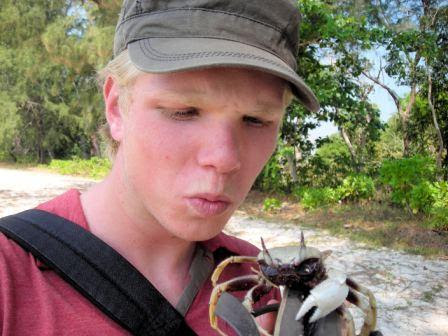
Some crab are for eating, some for watching.
ALISHAN headed straight for Patong. It was time Tom got to see a different side of


Our next stop was

Kata, Karong and in the distance


At an elephant farm between Kata and Nai Harn
Suddenly the SW swell returned and ALISHAN started rocking and rolling, pulling the chain. The lee shore was too close by, we had to move. So we left, motor sailed around the south point of Phuket to the east coast, and anchored 3 hours later in Ao Chalong. We had been here several times before, to clear in and out of the country. The bay is protected all year round and home to many local dive and tourist boats that visit the nearby islands. There is a noisy little town with some shops. Nothing special, but here we were safe from the wind and the waves. Now, what about Tom? This had all happened during his absence. He was out on a dive boat for his first open water dive at Phi Phi. There could have been a problem were it not that nowadays everybody has a mobile phone, even when on holiday in


The big Buddha of Phuket

When Tom had his desired certificate we set off again, this time to the islands in Phang Nga bay, east of Phuket. A couple of stops at lovely and quiet Ko Yao Yoi, where we explored a bit of mangrove and plantation, brought us to Ko Phanak and Ko Hung, both uninhabited, limestone islands. We did a few different caves this time and got up early in the morning to visit the most spectacular hong at Ko Hong. Just like 6 months before and it was just as serene. I love that place.
(See also Q3 08)

Ko


Cave exploring


ALISHAN in
New for us was Krabi, a rapidly popular becoming tourist destination. We anchored off Rai Le beach, The Place for rock climbing, but decided not to venture up. Instead we went down a few meters on a snorkel tour around the rocks. Much more relaxed.

And then came Phi Phi. But not before another snorkel stop, at Koh Dam Khwan. We saw quite a bit of fish there, and one spiny lobster. The visibility was so so but hey, after the Surins it’s hard to find something that spikes your senses.
Phi Phi island is fun when you are young and love discos and that kind of stuff. For us it’s convenient because we can have the laundry done and buy fruit and veggies. Of course eat out. Thai food has risen to one of our favorites. That means, as long as the amount of chili is reasonable. We love the papaya salads (normally prepared with 12 chili peppers, but for us with just one) and Tom goes for prawns. In Phang Nga bay we did get some from the local fishermen, which were super fresh of course and fried Marijke style, scaled raw and rolled in a mix of flour and spices tasted superb.


Views of Phi Phi Don
One evening in one of the open restaurants in town we got some extra nutrition when a squadron of flying ants landed on us. We were just finishing up when suddenly they were everywhere! In your hair, under your shirt, on your plate and as soon as you opened your mouth for a bite they crowded in! It was impossible to endure. We paid quickly and hurried out to the other, ant-less end of the street.

The best of Thai cuisine: curries and salads
Ants fly low and time flies by.
We had only a few more days before Tom had to fly out to

Jaap and Tom enjoying their Thai massage in Nai Harn
Bye bye, Tom. It was good to have you onboard. You can come again – any time. We still have some fishermen’s pants. (see blog)
http://syalishan.blogspot.com/2009/01/phuket-2009-learning-trics.html


Market scenes,
The lady below is selling us a durian. We just love that smell!
The original plan was to sail to the Andaman Islands of India after Tom’s visit. We had applied and gotten a visa for this when we were in
Visiting yachts have to report by radio twice a day. Fees had to be paid just about everywhere outside the city of
Instead we took our time and left Phuket to “sail” to the Similans, another group of island that is a
First we sailed to an inlet near Kao Lak, Thap Lamu, 35 miles north of Phuket.


Jaap inspecting the fish traps.


A fisherman getting his tattoes
The best place to anchor was just off the naval base, half a mile upriver, in front of a small town. Ashore we came across a surprisingly big hardware store (good to know for future expeditions), a cheap barber (1 euro) and a lively fishmarket. A short dinghy ride through mangroves took us to a lovely old plantation with numerous birds. We stayed an extra day, enjoying the calm waters of the river, after all the open bays of the previous weeks.

Children of Thap Lamu
In the Similans we found moorings again. And dive boats that stayed overnight, but not too many. Again we enjoyed the underwater world with our mask and fins. This time it did match the Surins in variety of fish and other creatures, but with less coral. Big grey granite boulders form the landscape here, above as well as under the waterline. There were turtles and life humpback cowries, lion fish, scorpion fish and several different kinds of pufferfish. Even Nori and Wakame liked it. They could watch schools of fish at several meters depth from the deck, which Wakame found most entertaining. She never showed the urge of jumping after them, though.
We met up with sy Mata’irea with Sten and Danika, who we’d first seen in Nai Harn and shared our views of this place. We also hiked up to the top of one of the islands, hoping to see some Nicobar Pigeons again, but…

Back in Phuket we headed straight for Patong, where we dropped of the laundry, bought CD’s, DVD’s, souvenirs and groceries. The bay was quite rolly – again – and now dark clouds came in at the end of each afternoon, resulting in some serious thunderstorms. Winds would pick up to 35 knots, but we could still here the sound of fire crackers, that announces the departure of a seagoing vessel. The boats that take tourists out on sightseeing and diving tours to the outer islands are all locally build with local funds and local knowledge. In other words they are not very seaworthy and when seas get rough they tend to simply roll over, top heavy as they are. It wasn’t surprising that one night one of the boats didn’t make it back. 6 people drowned. Others were picked up. Sad. Locals say it happens every year…


Cats on the lookout, waiting for that fish
Again, conditions chased us out and on to Ao Chalong, We packed our stuff and got ready to leave
After clearing customs and immigration we left Phuket and headed south towards
The southern part of
The first night we anchored at Ko Lanta, off the SE point, without going ashore. Difficult, I like Ko Lanta, but we had only 10 days. The next day we continued to Ko Rok Nok, a bit further west, away from the muddy waters of the rivers on the mainland and found a nice spot between 2 little islands on the north side. We had heard about the beauty of this place from other yachts and wanted to see it before we left this part of the world.

Campsite on Rok Nok
The weather played games again; we were getting close to the wet monsoon and winds started shifting. The thunderstorms that were hovering over the mainland came closer. The 2nd night conditions became so bad, we had to move in the middle of the night and made an hour long d-tour to the other side of the islands. With use of a nearly full moon we worked our way towards the coral reefs and found a mooring at 2:30 am. What a relieve! There we stayed another 2 days near a pretty beach with some pretty birdlife and monstrous lizards. We were clearly getting closer to Langkawi.
Our last stops in

A river on Ko Adang, reduced to a tiny stream in the dry monsoon, sporting hornbills, monkeys, drongos and 2meter monitor lizards.
And that was it. Bye bye

In Langkawi we had a few days in Telaga and Rebak before we flew to


Byebye!


Similan Islands via Kao Lak


Phuket to Langkawi
BIRDS

Sandpipers

Brown Shrike


Blue-eared Barbet


Black-crested Bulbul

Stripe-throated Bulbul


Black-headed Bulbul Orange-bellied Flowerpecker

Red-eyed Bulbul


Common Myna White-vented Myna Hill Myna

Sunbird


Yellow-vented Bulbul and it’s chick

Cormorant


Coppersmith Barbet

Coucal


Scaly-breasted Munias

Asian Brown Flycatcher
FLOATS


Thap Lamu


Thap Lamu

Kata


Patong


Siray

Patong

Thap Lamu
Funny

How many legs does it take to carry a longtail?


Cheers!

Internet connection on ALISHAN
Marijke is holding the antenne out on deck through the hatch, while operating the computer.

MTR: Not Mass transport but Mast transport


Find the shark. For information, contact Tom
SALUTE


No comments:
Post a Comment